Sunday, February 19, 2017

Know thy impact

I attended a course recently that brought Hattie's work to the forefront of my mind again. I have returned to his Visible Learning book a few times since a teachmeet friend (JP) related Hattie's work to his own forest school work. It made a lot of sense. 

As far as impact goes, Hattie has done all the hard work for us, with extensive research to tell us what works best in education. By ranking 195 influences and their effect size, Hattie is pointing us in the right direction of what we should be taking notice of and what we should not waste our energy on. I'm not going to analyse that here - time is short and I'm sure if you google it you can find much better blog posts than I would write. What I wanted to share was my 'so what'. 

In this recent course we were told how research shows that the greatest impact on learning is student self belief / expectations of themselves. I know that there are lots of things that I do to promote this already. I traditionally start each year with Trevor Hawes optimal learning approach, whereby (in a nutshell) children learn about their brains and how they learn (metacognitive strategies are ranked at number 4), then recognise their smart areas and liken themselves to someone famous that they can aspire to be like. 

As a school we promote growth mindsets - that effort is valued - and we use strategies such as Austin's butterfly to show children the value of critique, feedback and effort. 

I ask the children to rate their effort during and at the end of lessons, using their fingers (this was another teachmeet tip) and they are very honest. I ask them to congratulate themselves if their effort has improved by the end of the lesson. Sometimes I ask them to show me by putting their thumbs up if they have improved, but mostly it's about them acknowledging that great work is often linked to effort. 

Despite my efforts, some children still do not possess that self-belief or 'can do' attitude. So here's what I intend to do next term to support them further:

1. Reinstate #proudofmyselfie so that children acknowledge when their effort has led to great work

2. Trial a weekly genius hour. I am half way through a blog post about this, which I will finish soon. Basically I will support children to develop the skills to use their hour wisely, to pursue their own questions / learning. I hope that high interest will mean greater success, leading to that self-belief that some lack. This idea is based on the 80/20 work model. If it appears to be a gimmick with little impact, I will drop it at the end of the half term. 

3. Ensure that children continue to develop their confidence and self-esteem through forest school type activities. This really does enable them to learn (and apply) so many important skills. 

4. Continue to be honest with my feedback and ensure they all buy into the notion that failing / 'breaking' things is a great way of learning (they will say they agree with this, but I know they don't all believe it. Yet!) 

5. Continue to provide challenges that develop their resilience and problem solving skills, particularly in maths and ICT/computing

I will review what we have done at the end of the half term - particularly genius hour - and will ask children to review their learning too. My children are very young (7-8) and measuring the impact may end up being anecdotal.

Update 25.02.17

The idea of genius hour has been well received by my children. To establish good habits, for the first couple of weeks I will give them a theme. After that they can choose their own questions (within reason - I did have to explain to one child this week that she would learn how babies are made when she gets to year 5 ...). So to start with, their questions will be inspired by our science topic of humans and other animals. I have read all of their questions and completed an online resource, linked to their class blog, to help some of them find information quickly. A few are asking similar questions, so will be encouraged to work together. At the end of last week they went to the library to see if they can find a helpful book or two. I'm looking forward to seeing how this goes!

Sunday, January 1, 2017

#Nurture 16/17

I haven't blogged a great deal this year as I have been trying to find more of a work-life balance. That has been hard to achieve at times (I know that I am not alone there). I thought it would be cathartic and, possibly, a positive way to reaffirm personal and professional achievements. So here goes...

Reflections of 2016

Our dogs

It almost seems trivial when there has been so much suffering last year, such as events in Siberia, the loss of lives from the earthquake in Italy, the terrorist attacks that have destroyed families, but the loss of our beloved dogs was heart-breaking. They were approaching their thirteenth year and we said goodbye to Macy in February as she had lost the use of her hind legs. It was the kindest thing to do. We were absolutely devastated that Sabre fell ill within a month. Possibly from grief. She had seemed so spritely and it was a massive shock when she died. It was a huge loss to our family and nobody wanted to be in the house on their own. Nobody wanted to be the first home from work as the house was just so empty. We made sure they had a beautiful resting place, in a lovely field with a beautiful view and they have been placed in their running position, with some of their things to take them into the 'afterlife'.


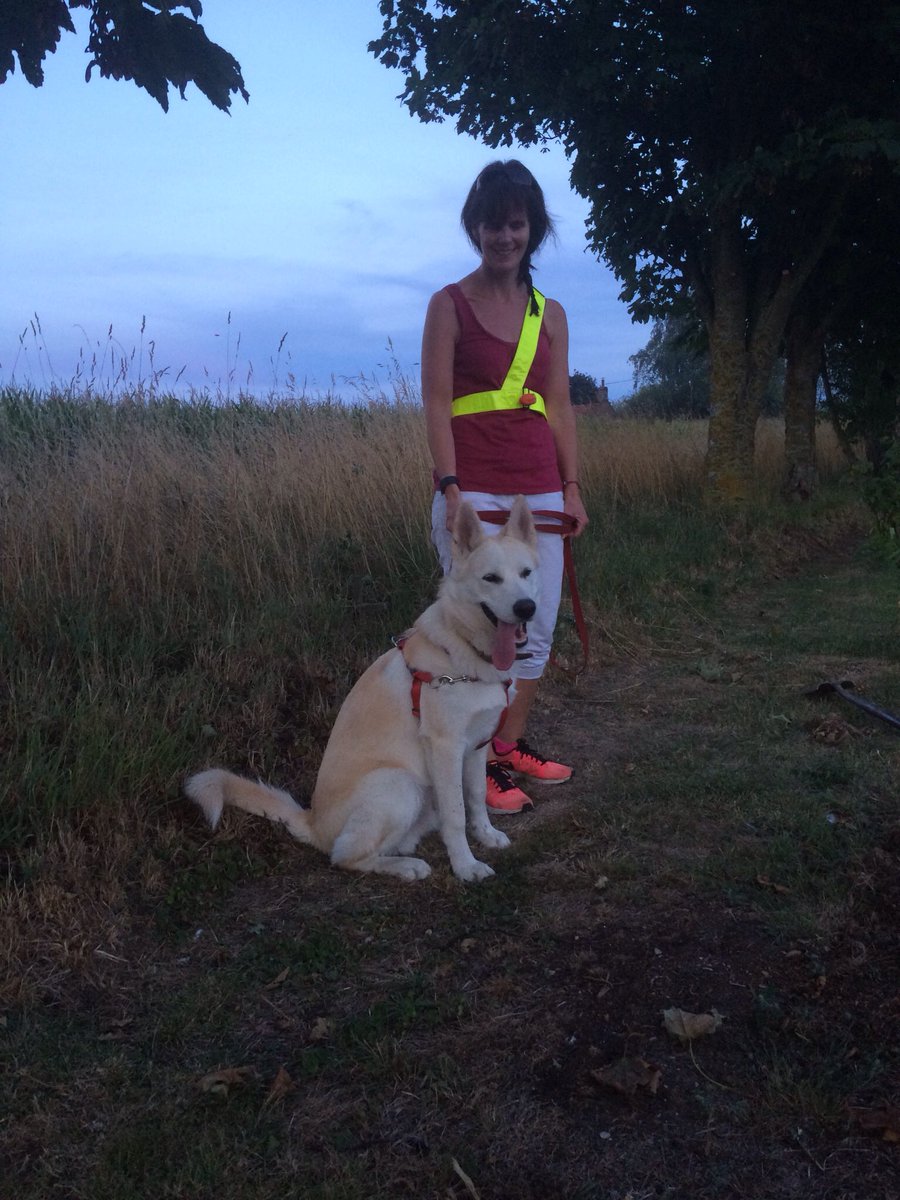
Grief for dogs is hard, as I'm sure anyone who has them will know. Small things can trigger emotions, but you don't feel like you have the right to be upset when you know that there are people who have lost, or have very sick, family members. My cousin died just before Christmas last year in a car accident, leaving two children, a twin, a sister and two devastated parents. Losing elderly dogs does not compare in any way to this and yet I had to go through a grieving process. One of the more rash things was to search obsessively for a dog to fill the gap. We have welcomed to our family Beau, our first male dog and one who looks similar, but totally different to our beloved girls. We have rehomed him from a family, so he is great with children, though possibly has a slight attachment disorder... He will hopefully be a good running partner in years to come.

A run down to Macy and Sabre's resting place


China

Last year I was able to tick off this destination in my bucket list. It was an incredible trip and I had a fantastic travelling partner, Ann. We booked the trip through Responsible Travel, which meant that we were tourists who helped local communities. We travelled from Shanghai, to X'ian then on to Beijing and the Great Wall of China. There are far too many highlights and I could not write them all here, but I have to say it really was the trip of a lifetime.


OfSTED

We got the call in October, just shy of the two years when we previously received a grading of RI. To put that in context, they had sat on the fence during the last inspection and there are things we maybe should have done in hindsight to convince them we were good. I never doubted that we were. All visitors, our cluster schools, supply teachers etc seemed shocked by the outcome and it had an impact on staff morale. From my perspective it had felt like a fair inspection. Rigorous, but fair. Our inspection this year felt very different. It was fast-paced - as expected - and gruelling. The fact that our OfSTED fell at the same time as parents' evening and the handle broke on our HT's office, locking us out for a couple of hours (seriously!!), didn't help. 

 It felt like a fight, but I am proud that it was acknowledged that we are a good school and that we know our children really well. OfSTED understood our curriculum and ethos and the benefits for our children. I feel sad that they did not come and watch me teach, because they would have seen a passionate teacher, eager children who have made phenomenal progress and lots of Jambots at one point! It was a huge relief to wave goodbye and to have the half term holiday to recooperate. 

Social media

I spent less and less time on twitter last year, mostly because I was fed up with the spats that were taking over my timeline. My hackles kept going up because I couldn't understand why educational professionals, who should know better, would publicly try to humiliate each other (we all do a difficult enough job as it is). Even experienced professionals get it wrong sometimes and I believe that humbly admitting that is a quality I respect. Some professionals just have to 'see' that there are many ways of viewing the educational world.

 I have stated my opinion before now, then immediately regretted getting caught up as I know that I am neither quick nor articulate enough to respond in a tweet. The best option seemed to be staying away - and by that I mean not scanning through my timeline. I have tried to reduce the people I follow, but that is not easy as I still want to read influential blog posts.

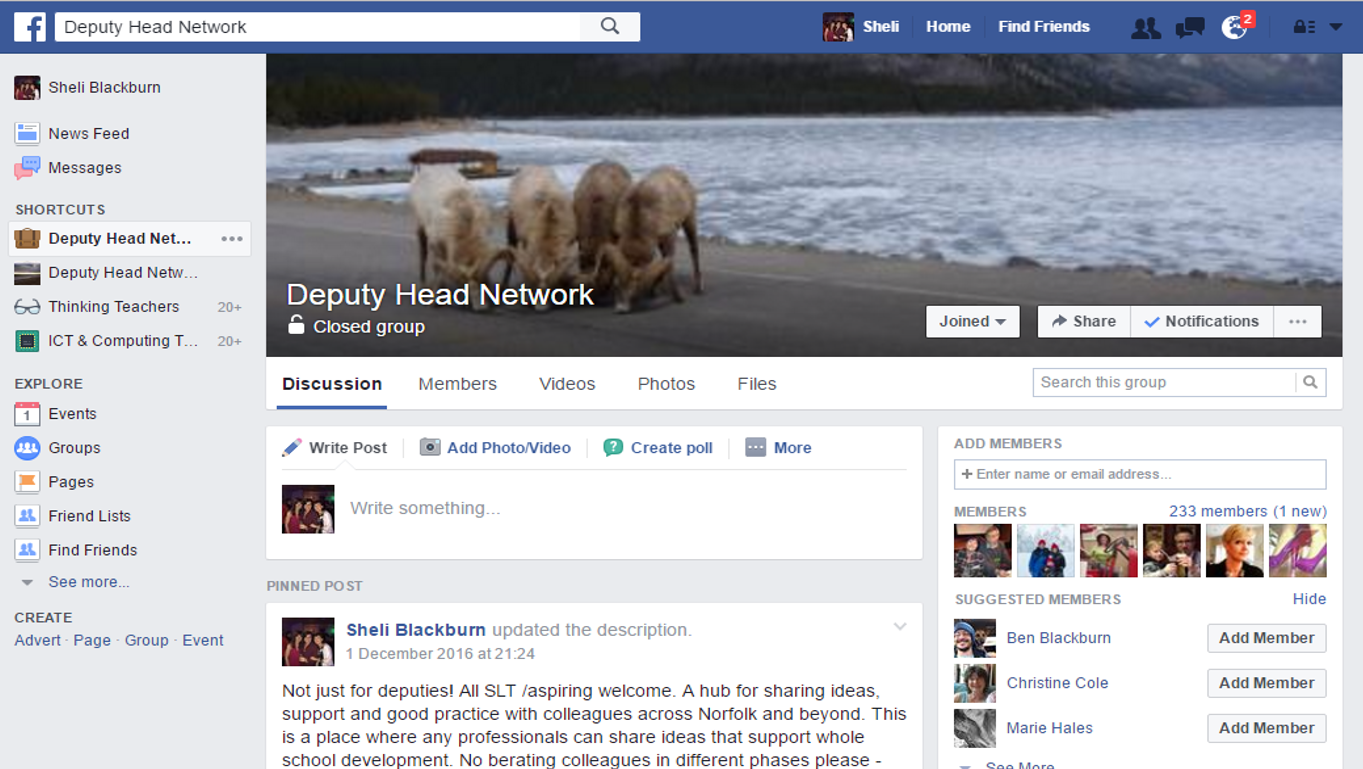
One of the positive things I think I have done this year is to start the deputy head network. It was an attempt to encourage folk to share blog posts, news etc through facebook, saving folk like me the twitter trawl whilst enabling us to keep up with current events and innovative ideas. If you are not a member, please do come and join us. You don't have to be a deputy, just passionate about progress and interested in lifelong learning.


We have also managed to reinstate #DLChat on a Tuesday night, which seems much better for the majority of folk. It is great to see that the hashtag still gets used and that new people are joining in. Some long-standing advocates, like me, have different priorities now, but they still make time to share the thoughts and ideas. Long may it continue!

Being a SENDco

I passed the SENDco award in October. The work load was unsustainable, but there were many positive things about it. It added to a very busy year, with year 2, deputy, SENDco, county moderator and assessment coordinator commitments, but I think I can look back and say that some of those things I have done well ...


My hopes for next year

These haven't really changed from my hopes last year. I want to be a better person and to be better at everything I do.

Sharing the education love!

My very good friend Jenni and I are hosting a SEN teachmeet/unconference next year (do come!) and I hope that there will be more opportunities to replicate this sharing of good practice. We are so lucky to have Mary Myatt generously give her time to this.

  I will endeavour to share more on the deputy head network and will attempt to blog more. I am hopeful that the reduced workload from the SEN course will allow me the time to renew my spark and the capacity to think outside the box again. I think that I have managed to give my children an exciting curriculum throughout, but am keen to do more things that will have an impact at a whole-school level.

Wellbeing

I hope that I can continue running, with Beau. My painful foot and his naughtiness have made this tricky at times. I know that I will keep reading for pleasure, travelling, enjoying the great outdoors and going to the seaside. I hope that I find more time for sketching and painting next year. I know that I will spend lots of time with family and friends, appreciating life! I still haven't managed to find a yoga class.

Lifelong learning

I shall carry on learning next year with educational reading, but would also like to learn to do something new. I'm not sure what. It may involve learning outdoors activities as I feel like I can put more energy into this in school next year, now that the year 2 pressure is off. I need to do some governor training and will also try and fit in a trip to the apple store so that I start using my mac properly. I know that I will continue to learn loads from my passionate, knowledgeable friends and colleagues: Amanda, Jenni, Judith, Becki and the Old Buck SENDco crew.

Digital leaders

I know that I need to push this more in school. I have my class digital leaders and I run a year 6 code club, but these are often difficult to manage when there are so many other things going on in school. I felt very honoured to be asked to deliver a keynote at an ICT conference again in 2017, but I felt like I had to say no. It's not because I wouldn't have anything to say - I could talk passionately about digital leaders for hours - but it feels a tad fraudulent when I am not the ICT coordinator at school and I don't organise the year 6 digital leaders. I keep my hand in with innovative ICT by getting together with the wonderful Kevin Sait and our enthusiastic code club members, but there's always more to be done.


Healthy eating

Maybe this will be the year when I limit my sugar consumption ...

Saturday, March 12, 2016

Using free technology to start a drama in the classroom

I love environmental issues, technology and drama, so mixing them up is something that makes the curriculum come alive for me. This week my class will become The Asian Elephant Rescue Centre (The ARC), based in the rain forest of Borneo. The first dilemma that will start us off is that a baby elephant has fallen into a water pit and is unable to get out. The mother is so distressed that she is charging at anyone who comes close. This will create opportunities for thought tracking, pupil in role, decision alleys and role on the wall.


As always, when  I am planning for mantles such as this, I have an idea about what I want to do, then I search google to see if anything exists that I can use (and pretend to be mine). There usually is! This time I have found video footage of a charging Asian elephant and a bay elephant stuck in a pit in China. Perfect! I can adapt those.


For the baby elephant footage, I have used screencast-o-matic to make it sound like I am recording the elephant myself. It's not perfect, but it will do. 


For the charging elephant I will use a video straight from Youtube, which I have downloaded to my computer using the ss trick as we can't access Youtube in school... 


A bit later in the 'story' I will use a news page, adapted using x-ray goggles, to help make the news our own. I am considering teaching my class to use this, but they may be a bit young. 


Something I will definitely use during this mantle is Doink green screen app. The children can record themselves as if they are in the rainforest,  near to the baby elephant, or the charging elephant. Of course they will be told that this is all in our imaginations. In my experience, my children have been disappointed to learn that things aren't real when we first start using drama in September, but by this point in the year they understand that we are using our imaginations to make our learning exciting. History (The Great Fire of London and Florence Nightingale topics) has been particularly popular.

Planning the smart way?

It has taken me under fifteen minutes to find and prepare the films, then about the same for the hacked news page. I will also practise using Doink at school, where I have some green fabric tucked away. The value in doing these for me is that they help focus my thoughts on where the mantle will go, to start off with. The children will guide the rest of the way. The point is that I have planned for a unit of work quickly, in a practical way, which is how I prefer to work. I have a 2 minute mindmap on paper and I may complete one using popplet (I will add it here if I do), but I won't have a detailed plan. I have the objectives in my copy of my class's curriculum for 2015-16, which I will highlight and date. Minimal paper plans, but lots of planning will take place throughout. Most importantly (in my opinion) is that I am excited about teaching this and I really believe that excitement and passion is picked up on and replicated by the children. We will cover geography, art, DT, ICT, PSHE/citizenship and English in this unit. Can't wait!

Sunday, January 31, 2016

Investigating mathematics

This is less blog post, more list of resources that I use to teach the new maths curriculum, as well as old favourites Nrich and the brilliant reasoning in the classroom activities. Don't forget the archived misconception resources too - they are very helpful for teaching points.


Edu Dudley lots of great stuff including finding all possibilities, finding rules and describing patterns, logic problems, reasoning about numbers and the mathematical challenges booklet. 

Maths warriors  investigations

Fractions 

Trinity maths hub - free learning schemes  and assessments for each year group (spring mastery docs can also be found here)

Teaching for mastery assessment materials

We have also purchased the Rising Stars problem solving and reasoning books at school, which have good activities and good approaches to maths

More will be added as I remember them!

Improving working memory

I have played this app a few times, with varying degrees of success I'm ashamed to say! I think it could be a useful app for children who need to improve their working memory, attention and concentration. Ribbit frog Ribbit uses sound and visual cues, much like the old game Simon, but in a linear way. 

First you press to show you are ready. 


Then you listen to the notes, which increase or decrease in amount depending on how you are doing.


At some point when you repeat the sequence of notes, a coloured note pops out of one of the frogs' mouths, which you then have to identify at the end. 


If you get the sequence wrong, the frog falls off the log. I'm not sure how long it would keep a child entertained, but I can see how regular short bursts could improve a child's working memory and attention skills.  It's another one I will be trying in class.

Another EYFS /KS1 computing app

I have been playing with the Foos this morning and it's another nice free app for EYFS and KS1. 


It uses drag and drop blocks that scaffold learning. 


You can change the direction of your blocks by clicking on them, then select from arrows.


After you have mastered basic walking and jumping, it introduces the repeat command.


That's as far as I've got at the moment, but I can see that children will enjoy playing with it from what I have played. I will try it with my mini digital leaders next week. It requires some computational thinking, though doesn't challenge like other apps by asking children to think too much about direction. This is good for the children who find apps such as Beebot too challenging. 

 My only other criticism so far is that you don't have to be overly precise with the jumping/adding blocks. I was successful even when my code wasn't quite accurate. A nice start to early coding though.


Wednesday, January 6, 2016

#DLchat as a Slow Chat

Most people who know me know how passionate I am about having digital leaders in schools and the benefits they can have. I have been known to nag folk about hosting #DLChat - and posting on the digital leader network. #DLchat and the Digital Leader Network are a collaboration between like-minded people and not owned by any one person; it's the energy shown by a great community of professionals that keeps them going. 

I'm not quite sure exactly how long #DLchat has been going, but over the past few years we have had some really successful chats on a Thursday night. Some weeks have been quieter than others and lots of regular chatters have had major commitment changes over the past few years, though remain as passionate as I am about digital leaders. A couple of years ago I asked people if we should change the chat to a different night as many people had other commitments on a Thurs. It was felt at this time that it should remain the same. I do now feel that a different format is needed, to keep the chat going and to include more people. If you check out the # each week, tweeters have shared photographs, blog posts and events with their digital leaders and more of these people might like to host if they weren't tied to a Thurs night. 


When @Bekblayton proposed that we trialled a slow chat, I thought this could be a great way of keeping the chat going, whilst involving and including more people. A slow chat happens when someone poses a question, then it is responded to throughout the week. An alternative (thanks @clcsimon) is whereby the host posts a different question each day throughout the week. We can find it by searching for #DLchat and following the threads.

So now that it is more flexible, there is no excuse! Here is the document you need to sign up for hosting! When you sign up, you can state whether it is one (or more) questions / ideas / topics for the week, or whether a new question will appear each day. It's entirely up to you!


I think that this way we will include more international digital leader advocates and we can learn from each other. It also might just tempt those who are put off by the fast pace of the chat as responses can be slower and more thought out. 


So to kick off this week's slow chat, tomorrow I will be asking: 

Q1: What are the benefits of having digital leaders? 

Q2: How have they contributed to school improvement? 

Q3: What difficulties have you encountered when supporting digital leaders?

These will hopefully appear throughout the day ... 

I'm relying on others contributions, as I am now attending an an unexpected meeting on Thursday from 6pm. But that's ok, because the slow chat can continue for a whole week! So please do join in. Don't be shy or feel you can't contribute because you haven't before - all views and ideas are welcomed! We can learn a lot from listening to one another and sharing oue good ideas. 

Saturday, January 2, 2016

#Nurture1516


Having just looked back at my nurture 14/15 post, it was interesting to reflect on my hopes. #DLChat has continued, my ulcers have been kept at bay, most of my closest friends remain fit and healthy and my children are doing well.

Reflections of 2015

Computing

Despite feeling like it has taken a back seat to SEN this year, I managed to deliver a keynote at a conference in March, have run a code club at East Harling and have employed mini digital leaders. Although I feel I don't have enough hours to remain at the cutting edge, I know I am still doing my bit. #DLChat continues, though it maybe needs a rethink this year.

My children

Ben came home in July and will commute for his last year at uni. This is good as I can pester him to work hard and to try and keep normal hours... We have a lot of study chats now I am a student again and it is lovely to have him home. Jake has bought a house and I am dead proud of him, even though it has left me feeling very emotional. He is moving next door to one of my best friends at primary school and although I know she will be there for him, it feels a little weird that she might see him more than I will.


                                                                                                    Yoga

#nightrunner
One of my hopes last year was to find a yoga class. I failed with that, but have found a pilates group. The phrase 'zip it up, front bottom, back bottom' is now one of those that pops into my head at all times of the day! I have also started running. After years of being a fine weather fartlek* runner, I bumped into a friend who told me I could run without stopping, that the first km was always the hardest and that I just needed to tell myself that I could do it. The next day I ran 3km without stopping. In my jeans. This carried on 3-4 times a week for a few weeks until I bumped into the same friend who said her husband thought he had seen me out running in my jeans and they'd had a good laugh about his eyesight... I had to admit that I didn't feel confident enough at that point to put tracky bottoms on, so if anyone saw me walking they wouldn't think I was a naff runner... Looking back it seems a bit ridiculous now. My son started running with me a bit later in the year, which helped me up my pace. Despite preferring to run alone (or with Jake - but we don't talk so that doesn't count) I said yes when I was asked to join in a charity run. Realising that I wasn't that bad was a really good feeling! As I'd been out once in company, I decided to join a local running club. I've not looked back! I'm not particularly competitive, but know that keeping it up is great for my asthmatic lungs and wellbeing (I can only concentrate on my breathing and looking where I'm going whilst running so have a real brain break). I feel like I have conquered the 5km and have managed an 8km route on occasion.

* Ben is doing a sports science degree and has told me that what I refer to as fat lady's running (I know that's not PC, but I didn't coin the phrase) whereby you run for a bit, then walk (and repeat) because you don't have the stamina to keep going, could be passed off as doing it that way on purpose i.e. fartlek.

County moderation

I trained to be a county moderator last year, which proved to be very interesting. We had to offer four dates to work, then were told that the county was being inspected ... you guessed it, on one of the dates I was moderating. It was ok though as there were five moderators in that day and I was the only newbie, so I thought I might be left alone ... Nope! The inspectors plonked themselves down on my table and looked at how another moderator and I were hosting the sessions.  It was all good though as we were commended on the way we moderated work. Phew!

Social media and blogging

They have both taken a back seat this year, much like computing. I haven't had to time to blog properly and have started and not finished about 10 posts over the year. I have stepped back from twitter as well, for two reasons: it takes up too much of my time reading the posts that I think will inform my practice or following interesting threads; some of the arguments/statements on twitter were raising my hackles. I'm sick of the phonics debates. I'm sick of high profile secondary teachers slating primary teachers, then refusing to answer challenging questions because some of us are too insignificant or don't have enough 'celebrity' status to respond to.

I did set up a deputy head FB page as a place to share SLT stuff, which I will try to promote next year. I think it could be a valuable resource if we get enough people sharing. I have tried to support @SENexchange, but must do better, and have almost kept up with #dlchat.


My hopes for this year


Family and friends

Life is precious. A tragic death in the family before Christmas reminded me of that. I will continue to ensure that at least one day each weekend is spent with family and friends. I hope that I will become a nanny at some point (Nanny Pidge) though next year might be wishful thinking. I hope my lovely friend Sue gets better and that other close friends have good news about health issues in their families. I look forward to bicycle shop / prison cafe meet ups with Jenni, Becki, Rubes and Judith, seaside walks with a range of friends and lots of afternoon teas with Linda, Sal, Jo and Becca. I hope I get to more gigs next year than I did last year.

BIG weekend
Travelling

I hope I get to China this year after an epic fail last year. I did manage Scotland, Munich, Whitby, Wales, countless beach trips and both days at the BIG Weekend, so musn't grumble! After climbing Snowdon last year on my birthday, I'd like to climb Scafell and Ben Nevis this year.


New SENDco award

It needs to be done. I need to stop grumbling about it! (Sorry Amanda...)

Digital leaders

I hope that we can do something innovative this year - possibly with @kevin_sait.

Reading

I want to manage to keep up with reading for pleasure in amongst the abundant SEN course reading. Our book club will continue and I have a stack of new books on my shelf to read. I got 'A Boy Called Christmas' for Christmas, but haven't started it yet ...


Sketching

It's therapeutic. I need to spend more time doing it. A child in my class bought me an A5 sketch book, which will now go to the seaside with me.

Friday, October 30, 2015

Thinking out loud: assessment

In amongst my roles at school is that of assessment coordinator. It's in the back of my mind a lot and as a county moderator I am acutely aware that we need to produce a system for our school, grounded in our curriculum, before I go out and act as a critical friend to others. For that's all I can be at the moment. With so many different systems, questioning a school's rationale for the systems they have in place may be the best I can offer.

 The confusing aftermath of the removal of levels has been captured brilliantly by @theprimaryhead in his blog post, Who Needs Levels Anyway? If you need a good chuckle, it's a must read! (Don't read whilst drinking tea. Spitting it out could seriously damage your tech!)

So how can we develop an effective assessment system?

As an advocate of all things formative, I agree with many of the messages in the Final Report of the Commission on Assessment without Levels and of course Dame Allison Peacock's Learning without Limits. I have written about this before, but having seen fleas in a jar it captures beautifully (scarily?) what happens when you put a ceiling on children's learning i.e. by levelling them.


 I have questioned my own practice considerably over the last few weeks, particularly in maths, and wonder if I have unintentionally been putting some of my children in a jar. That is another blog post, but some superb maths CPD and a relective moderation meeting have challenged my ideas and are helping me move forward. Although I heartily agree with much of what Tim Oates says, I have blindly followed some assessment systems without questioning them. Carry on learning eh? 


So here is what we have done so far at East Harling. It may not be perfect (yet), but it's our story and therefore we can redraft and tweak it as and when necessary. This will be essential over the next couple of years as we adapt our curriculum and aim to create a seamless system whereby assessment is an integral part of teaching. (When I say 'we' I am not elevating myself to royalty, but referring to our SMT, which consists of my HT, English, Maths and curriculum coordinators. Four of us have been deputies. It is an experienced team).

We use Pupil Asset at school, which I quite like. Under the new curriculum it takes the NAHT KPIs and allows you to click beginning, developing, embedded and not achieved for children. It then provides a DNA strip that will quickly show you what a child is able to do and where they struggle. For maths the KPIs are clumped into 'domains', though in the National Curriculum it is made clear that rich connections should be made between them, to develop fluency. 


At school we acknowledge that not all teachers are as familiar with this. We haven't had a staff meeting on it yet and you can't assume that everyone will have had a play with it. Equally, some teachers prefer to work on paper. Because of this, at the beginning of the year I created paper based tick lists for Maths (tweaked by our maths coordinator), based on the KPIS, and today have spent time creating them for English*. They need to be used in conjunction with the National Curriculum and the NAHT assessment frameworks and it is important that, especially for maths, you are not just assessing content, but fluency, reasoning and problem solving. Our expectations must exceed the NAHT descriptors so that learning is not limited (especially in writing where they seem low for some children). Because of this, our assessment sheets identify where an objective has been seen, (the child is) secure, (the child is) fluent and can reason and problem solve- the greater depth part. The latter may not be 'tickable' until the end of the year as children would need to show that they have mastered the skills across different contexts. I think it may prove hard to measure - and could be very subjective. This itself causes problems as schools may differ in their expectations as to what fluency and greater depth look like. 

I think that the Rising Stars assessment progression frameworks could prove invaluable. Why? Because it reminds us that we must not just focus on the things we are assessing (fleas in jars?), but all the things that will help make our children competent, confident, inquisitive, creative and expressive mathematicians, readers and writers.  

This is particularly important for new teachers who will not have the knowledge of the breadth of the curriculum, or those missing objectives. Likewise, they may not understand all the components that would make a child fluent with concepts such as place value, that the KPIs are only the big ideas that save us assessing countless objectives. And that's what we need to decide and tweak for our school by asking questions, like: What are the big ideas in our curriculum, the things that children must know at the end of each year? I anticipate that our method of assessment will be tweaked continously until it fits us. What we are desperate to avoid is the limiting of learning that Tim Oates and Dame Allison have attributed to levelling. Can we find an effective system that doesn't do this? If you have any thoughts or ideas, I'd love to hear them!

If you want to reflect even further on this, read (or re-read) @michaelT1979's 'Have we forgotten the rationale for scrapping levels?' or hot off the press, 'Updated assessment journeys' by @tim_jumpclarke. 

I'm still wondering how many schools are doing the same thing, creating systems, questioning what they are doing, becoming confused and going round in circles ...


* I will share these via google docs if anyone would like a copy

Tuesday, October 6, 2015

Maximising the Impact of Teaching Assistants - reflections from inspiring CPD

Today I was fortunate enough to attend a free conference at the UEA about maximising the impact of teaching assistants*. The presentations centred around the very helpful guidance document, 'Making Best Use of Teaching Assistants' from the Education Endowment Foundation, which does what it says on the tin. I used snippets of it in teaching assistant meetings during the last school year, but know that more needs to be done (there's always more to do isn't there?!) This report provides 7 recommendations for maximising the impact of TAs and provides guidance on effective deployment. The conference today reminded me about what this report says - and it is always good to have opportunities to refresh your memory. I highly recommend it to anyone working in the classroom.


The impact of teaching assistants has received mixed press over the years and the role has changed significantly. I don't think anyone can disagree with the guidance that they should not be used as substitute teachers for low attaining children - our least able children need consistently high quality teaching if the gap between them and their peers is to be reduced. Jonathon Sharples and Rob Webster talked about how TAs are effective when interventions are structured, high quality training is provided and TAs are prepared. Simple, common sense ideas that we aspire to at East Harling. Most of our TAs have received Read, Write inc training and our great phonics results are testament to the impact this has had. Equally, the impact of 1st Class@Number has been significant. With both of these interventions our TAs receive ongoing support and high quality training. They have guidance to refer to and although the structured lessons may make some teachers grind their teeth, they provide appropriate scaffolding for TAs to deliver high-quality lessons. When I have a TA in my maths lesson, I try really hard to give them a written plan, such as Numicon activities, so that they have something to refer back to whilst supporting a group. Quite often TAs are expected to follow a stream of verbal instructions, without being shown expectations. No wonder they sometimes get it wrong. To ensure that our support staff don't inadvertently confuse children, objectives and activities need to be clear, through appropriate guidance and careful monitoring.

Another important message was reiterated at the conference: we must ensure that TAs realise that they are not judged on the amount of work a child has completed. We are probably all guilty of thinking that children haven't done very much, but actually the conversations, thinking and experimenting that has taken place will have a greater impact in the long run. We were introduced to the concept of the 'snow plough TA', who pushes the child through the activities by providing answers and not really expecting the child to think or problem solve. We are aware of the minimal time that teachers give children to answer a question, hence the use of strategies such as think, pair, share, talking partners, popcorn etc. We were told that the average time a TA gives is 1 second ... It is our responsibility to do something about this, by training TAs appropriately. Questioning techniques are paramount too, which is why we use the Q-Chart at school - it reminds us about open and closed questions and those that promote deeper thinking. Things like this are not just for teachers, they need to be shared with everyone who works with children. A deeper understanding of the importance of this must be made explicit through training and discussions in the classroom.


Marc Rowland gave the analogy (taken from a fiction book) of people being taken up Everest with a guide, who falls to his death. Because he has not equipped the people with skills, he has merely 'pushed' them up the mountain, so they all perish too. This story got a shocked laugh from the audience and was a great way of demonstrating what happens when we don't promote independence or deep thinking. How true that many of our children develop a kind of learned helplessness because they have not been expected to try, think or struggle. 

Schools are accountable for how they deploy staff and the DISS project made it clear that it is our responsibility to fundamentally rethink how we use them, to ensure we are getting good value for money. Whilst it feels wrong to talk abut people in this way, I do agree that we need to work with the strengths of our staff. I was a TA for four years and I think I was deployed effectively for about 50% of this time. I'm sure that given the chance, most TAs could reflect on their own value in a school, and maybe there are cases where the SLT and the TA know that best use is not being made of them, but for many reasons things cannot change. One of the things that I did shortly after becoming a SENDco was to compile a TA register that showed training and skills. I believe that we deploy our TAs as well as we can, but I am also aware that there are skills that are not being used, because there are not enough hours in the day - and because sometimes it's the same children who need access to specific interventions, but how many times can you take them out of whole class activities. Incidentally, we were encouraged to do this - pick some children on the SEN register and count how many hours they spend outside the classroom. Juggling time and trying to do the best for each child can mean they are missing out on other important things in the classroom. It is a huge dilemma at times. 

There are things that I will do as soon as possible as a result of this course (purchasing the book and reading it) and some things that I haven't got round to doing, that need to be done, such as auditing TAs and trying to find ways of making time for TAs and teachers to spend more quality time together. The headteacher of St Andrew's Cof E school in Stockwell has developed some innovative ways of doing this, such as fortnightly meetings where the whole school has a music lesson whilst the TAs and teachers have CPD sessions together. The TAs are given a gap task - something to complete before the next session - which is supported by senior leaders. This culture of shared practice is having an impact, though the head acknowledges how fortunate they are to have the funding to do so. With almost 50% pupil premium, funds can be used creatively for the benefits of all children.

The Maximising TAs website has some great resources  for auditing the use of TAs, such as a deployment survey questionnaire and working in the classroom

As always, after CPD like this, I came back buzzing. Now I just need the magic fairy to whoosh a few more hours into the day!


*Where I have used TAs in this post, I am referring to all support staff in school.

Monday, September 28, 2015

My verbal feedback stamp

I sometimes use a verbal feedback stamp. According to @TeacherToolkit it's madness and it makes me a laughing stock. I'm sure I've been called worse, but it does bother me that an influential blogger - and senior leader - is stating his opinion in a way that could put a dent in some teachers' morale. And assumptions are being made about how and why it is used. Consider this, some teachers may use the verbal feedback for themselves. Not OfSTED, not the SLT (but possibly for parents). Regarding the latter, my son struggled with writing and when he was in year 6 the one really good (imo) piece of work was unmarked. If there had been a verbal feedback stamp then I wouldn't have questioned the lack of written comments. 

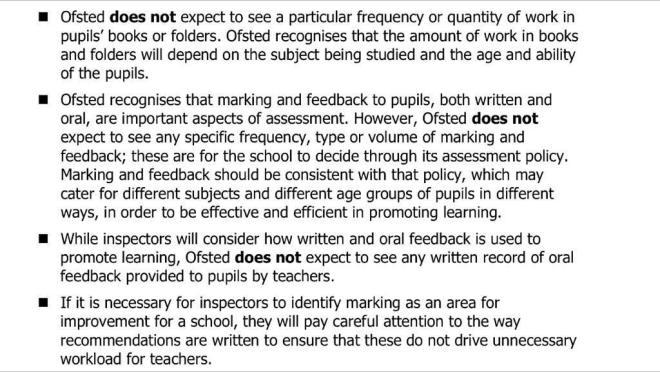
I'm well aware of OfSTED's marking guidance and wouldn't dream of spending time writing down what was said during the feedback, but in a couple of seconds the stamp shows that feedback has been given. It's something I strive to do - guide the children whilst they are working, to support their progress. I am fully aware that a stamp itself adds no value to learning, but the feedback does! 


For myself, I use the stamp sporadically, but it is for my benefit and certainly not proof that I am stamping for evidence trails (another assumption). I ask my children to leave their books open for marking, in a pile. If I've put the verbal feedback stamp on any, it acts as a reminder that I don't need to mark it again. That saves me time, which can only be a good thing right?! 

Today I used it in the middle of a maths lesson. When I looked at the subsequent work I could see that my verbal feedback had a positive impact.   How's that for self assessment of my teaching? So forgive me, but I'll keep my stamp, thank you - and make a mental note that when I have strong opinions about something I will avoid using words/phrases intended to ridicule fellow professionals.

Wednesday, September 16, 2015

How can digital leaders have an impact on the computing curriculum?


A post for #DLChat on 17th September at 9pm

I confess that my work with digital leaders has been sketchy over the past couple of years. I left the role of ICT coordinator two years ago, but that doesn't mean I have lost my passion for what I believe to be an asset to any school. We do have digital leaders at East Harling and I am fortunate to work with some of them in our code club, but I am not directly involved with what they do for the school. I have tried to get KS1 digital leaders going (mini DLs as I like to call them), but this has proved difficult despite their excitement about the role. Time is a problem. I aim to try again this year! The reason I am telling you this is that the following is based on experiences that are over two years old. They are still very valid and I actually feel very proud of what we achieved as a school before the computing curriculum became statutory. 

My digital leaders met at least once a week and had different areas of expertise, depending on their interests and what they wanted to learn. A couple were responsible for blogging and they updated their digital leader blog independently. They had lots of ideas, many of which came into fruition.


They hosted an open event where teachers and technicians (spot @kevin_sait!) came along to learn about the impact they have in school. I know that this had an impact as the ICT coordinator from my current school attended - and subsequently advertised for digital leaders. He has been supporting them in school for over two years now. 

So what about computing? Well I like to think that between the digital leaders and I we left a legacy of good practice. I was always quite hot on teaching the computing elements of the ICT curriculum as I knew that it was the part that teachers shied away from. Being an AST meant I had to know. I also wanted to find resources and ideas that would inspire children to engage and teachers to develop the passion to deliver confidently. So my digital leaders learned how to use - and become experts in - a range of resources such as:

  • Kodu
  • Mozilla thimble
  • Hackasaurus
  • Scratch
  • BYOB
  • Probots
  • Popcorn
  • Sherston resources
  • A range of ipad apps
I'm sure there were more, but these were the ones I remember most. I did not teach them, they learned by exploring, breaking things and through trial and error. Pretty much the same way that I have learned. It seems to stick better that way. 

They taught their peers during class ICT sessions, provided staff workshops and 1:1 support (depending on the teacher's year group), provided computing workshops for teachers in our cluster, presented e-safety sessions in assemblies, hosted kidsmeets, attended kidsmeets to learn new things and participated in cluster livewriting sessions to share expertise with other children. I have no doubt about the positive impact that they have had. I am very proud of one of my digital leaders who, after two years of campaigning to get her high school to employ digital leaders, has taken on the role herself. At the end of last year she had 20 year 7 digital leaders turn up! Wow! 


Of course the impact they have had is only measurable by the anecdotal evidence from other staff members, but I know that many felt more confident to try things out after they had received training from a digital leader - or they had them supporting in class. The laptops were being booked out more, staff were becoming more adventurous with what they were teaching and the children were leaving school with a greater level of skills.

I know that schools rely on passionate staff (or young people!) to keep any digital leader movement going. As a deputy, SENDco and year 2 teacher my time is very limited. My experience with year 6 digital leaders though was that they almost managed themselves. Some of them came more than twice a week and I was quite frank that they had to work things out themselves - and they did! At times all I provided was my room, meagre tips (and only when I could sense frustration) and the fact that I was available (often marking). So if you really want to get started but are concerned about protecting your time, promote an ethos of self-learned expertise. 

In #DLchat I would love you to share your successes and struggles. Maybe we can persuade others to employ them this year and find out for themselves what impact they can have.

Wednesday, September 9, 2015

Learning without limits

Today I have been fortunate enough to attend the conference 'Assessment without Levels' led by the inspirational Alison Peacock and Mary Myatt. The opportunity to hear their messages (and network with esteemed colleagues) made it well worth being out of my classroom. I had envisaged live blogging, but quickly realised that I would not be able to do it properly, whilst listening to what was being said. It was too gripping! What follows in an overview (I have written pages of notes) and I have refrained from putting in quotes so that I don't unintentionally mis-quote, but have tried to capture the essence of what I learned. This is my interpretation of the day, so some of what I have written is not precisely what was said.

Alison kicked off the day by reminding us that we need to keep our principles intact and our children at the forefront. This sounds obvious, but maybe it isn't for those schools who have been judged as RI or inadequate. It is a message that was reiterated by Mary in the afternoon, who told us that what we do is for the children's learning and progress, not for OfSTED. 

Alison was emphatic about not labelling children, but keeping the door open - enabling learning without limits. We are sometimes in danger of limiting the children with the labels that we give them, even if our intentions are good. Giving children a level may limit, or put a ceiling on, what you expect from the child, or they expect from themselves. 

What Alison said about mastery really struck a chord and was particularly relevant in the context of my practice at the moment. I am a fairly experienced teacher, but in no way complacent about what I do in the classroom. I am always seeking ways in which to be better. I am familiar with Dweck's mindset work having read the book a few years ago and from returning to it this summer. The radio 4 programme Mind Changers (in which Alison and her school appear)was part of our inset training on our return to school, with a follow up discussion about it in our staff meeting last night. I am really trying to think about growth mindset in terms of mathematics and to be frank it is making my head hurt. I have gone from thinking that I am a 'we can do it' kinda teacher with uber high expectations, to someone who may inadvertently been capping learning. 

Alison said that real mastery is not knowing, but questioning everything. You think you know, but actually you don't. Yes! That's exactly it! My thinking is being challenged and I have become confused with my maths planning. Luckily, Alison unknowingly gave me the solution to my confusion! Although I like to think I challenge children appropriately, in maths children were often grouped by ability - at least 3 times each week. This to me was the way to manage the tasks they needed to do, pitched at the right level, to help them make progress. Yes there were many days when they chose the level of activity and I provided lots of opportunities for more open ended maths where everyone had the same starting point, but essentially children belonged to groups. I could talk about the children who developed resilience, the ones who could do but couldn't talk/share their learning and the ones who had a positive view of their maths, but were inaccurate, but that could be a whole new post. The idea that Alison shared about differentiation through having challenges that children select (challenge 1,2,3 or 4) is something I am aware of, but have not adopted as consistent approach. It makes perfect sense! I've always considered it to be successful when I've done it, but have never considered doing it every day. Simples?! It's something that I can implement immediately and observe impact. Our children already have brilliant learning behaviours, so I'm sure will learn to select the right challenge for them, and we have a culture of trust, which is another thing that Alison was very clear about. Children must feel confident enough to voice their ideas, views and opinions without fear of threat or ridicule. They need to know that it's ok whether they choose challenge 1 or 4, that there are no judgements made.

Mary reinforced this in the afternoon by saying we are responsible for creating an atmosphere of high challenge, low threat, in which it's ok to make mistakes. These mistakes are vital for learning. Mary also said that if we work on a rich curriculum, we won't always know what will happe and with uncertainty comes challenge. This is why I love the mantle of the expert approach so much - the children lead, you can't always guarantee the direction you will go and the challenge is exciting! Everything these two ladies said made me think of this approach, from student voice to building resilience and positive attitudes - and giving all children equal starting points. If you haven't tried this approach before I can tell you that you I am constantly surprised by children's responses, which are very often contrary to what you would expect from their 'labels' (e.g. NC level). It levels the playing field. What this approach also does is provide ample opportunities for children to share ideas, make decisions and have an impact - all essential in the new OfSTED inspection framework. Mary asked, what do the children have to say? Student voice is one of the powerful indicators of where you are as a school. Pause and think about this.

Indeed under the new framework OfSTED will look for


  • Children who are confident and self assured
  • Good attitudes to learning
  • Children can discuss and debate in a considered way

Children need to learn to agree to disagree and that it's ok to have a different opinion or change your mind (drama techniques like decision alley springs to mind). OfSTED will ask what children are doing and why, so time needs to be invested on the latter. We must also make sure we identify and rectify misconceptions, check systematically for understanding, build resilience, give children time to practice and, most importantly, teach fewer things in greater depth. In the Q&A session at the end, we were reminded that it was ok to take your learning objective over more than one lesson. We need to stop rushing through the curriculum. I can't be the only year 2 teacher who is aware of a child who still hasn't grasped a concept, but has no more time to spend on it. Being given permission in the new curriculum  to slow down feels wonderful.

As for assessment, Alison believes that focusing on a rich curriculum, expertly taught, with low threshold, high ceiling tasks and a culture of challenge is much more profitable than focusing on levelling children. They are rigorous about the quality of teaching, rather than the levels the children are at. Yes they have to report ks1 and ks2, but they didn't spend time worrying about sub levels. We need to ask what difference we have made, what value we have added and what it is like to be a child in our school. Formative assessment (assessment for learning) is embedded and although summative assessment can inform, it should not hamper high quality teaching (big agree here!) Like us, they now use the NAHT KPIs, but in a slightly different way. These are aggregated at the end of each year and passed on to the next teacher (how it should be!) Assessments can be triangulated with work in books and will provide a scaled score for parents. Children are at the heart of parent meetings, which makes total sense as they are the ones being discussed. They produce short films where they self assess and these are shown in their learning review conferences. I love this idea and will definitely do this with some of our children on the SEN register as I think it is a great way of adding to case studies. 

If you want to read more about the Wroxham School's assessment policy, it is set out very clearly on their website

I could write more and more about the messages from today - and lots more advice was given by Mary about the new framework - but I feel this is enough food for thought for now. You can find out lots of brilliant advice on her informative website and I would highly recommend subscribing to her updates. They save an awful lot of time trawling through educational/social networking sites and are always helpful. 

I apologise for any typos (tired eyes) and will polish this post when I turn on my PC by adding some links, bullet points, bold parts etc (ipad prevents proper posting!!) 

I hope I have done justice to Alison and Mary's key messages. This really is a nutshell and I'm sure another blog post will ensue. 

Update: Amy has blogged! A brilliant read that picks up on lots of things that I had written down - and some things that I had only half written because too many inspirational things were being said! (Amy is clearly much better at multi-tasking.)


Please comment! 

Saturday, September 5, 2015

The Deputy Head Network


A colleague in my current cluster asked recently if I was interested in getting together with other deputies from the cluster on a regular basis, in the same way that head teachers meet. I thought this was a good idea. A couple of days later the deputy from my old school said more or less the same thing. I see three other deputies socially, regularly and we often talk shop. For me, one of the most useful things about getting together is the sharing of valuable information. For that reason I started a new FaceBook group - The Deputy Head Network


It presently has 35 members, of which three of us have shared ideas / links. Like other facebook groups, it is not exclusive to deputies. I am a member of the EYFS group and I appreciate the posts, love the ideas and have used one from it already. The Deputy Head Network could easily have been named SLT group or Sharing Good Edu Practice and is a place where any practitioners who have the mindset that sharing benefits children's learning and pupil progress, at a whole school level, are welcomed. It is also a place to share ideas and resources for staff meetings. In the spirit of the group, if you join it please share something great! I'll look forward to seeing you there.

Maths Minion!

Like lots of infant teachers, I have always had a class bear or two. The first way that I used them was to teach children about the world. The Bears went travelling, we plotted their travels using Google maps and the children shared photos and wrote journals (see the blog sidebar and one of the pages of their travels). Lily went to Australia, Old Trafford, Las Vegas and the Yosemite National Park, to name a few, all in one year! 

When I started at East Harling the class bears were used to promote free writing. By the middle of the second year I changed the expectation to reading the bears a story, because the quality of writing in the books differed greatly and I didn't want judgments being made. My children were asked to read a story to the bears and record what they (the bears) thought of it. 


This year I have one bear that will be a travelling bear and a very new Maths Minion to try. As a school maths is a focus area so I thought that one way to support this would be to put together a rucksack with Stuart, who needs to learn some maths as he finds it tricky. The back pack came with a handy pencil case, folder and notebook. I will add a laminated sheet with some activity ideas, which will include lots of games, mental maths skills and ideas to use and apply mathematical in daily life. I have also linked the Maths Wizards blog I made  couple of years ago (for a child with SEN) to our Class Blog as I know that many children enjoy using technology to play games. Hopefully this puts less pressure on busy parents.


I'm relying on the novelty factor of Minions to entice the children to take Stuart home with them.  The important thing is that it will be their choice what they do. We shall see how it works! 

Minion Me! My lovely class Minions!


Saturday, August 1, 2015

Holiday reading

Every so often I write a post about the books I have been reading and thought it was about time I wrote one again (well I thought it was about time I wrote any post actually...). I don't write in-depth reviews, they take too long and I am lazy. These are just brief synopses of some of the books I have enjoyed, with no plot spoilers and with the intention that you are not influenced by my views (I save them for book club). They are all, in my opinion, good books.


Elizabeth is missing by Emma Healey

This was a quick read that really struck a nerve. Alzheimer's affects many people and this book made me think often of my dear granddad. It is written from the viewpoint of Maud and weaves together her childhood and the disappearance of her sister, with the disappearance of her friend Elizabeth. The characters were believable, easy to relate to and I actually felt humbled by the patience of Maud's daughter (so much like my mum) and the determination of Maud. It made me laugh, it made me cry and was enjoyable even though it worried me (lots of books with realistic themes worry me).

Bone Clocks by David Mitchell

I am a big fan of  Cloud Atlas and have about four of Mitchell's books on kindle waiting to be read. At the moment my eyes are preferring real books though. Bone Clocks starts in the eighties and, like Cloud Atlas, has reality mixed with 'believable' fantasy, in both characters and events. I enjoyed it because I could relate to the teenage angst of Holly in the eighties and I like fantasy fiction. It was gripping from start to finish, with only a few 'what?!' moments (I liked the end chapters, but got lost/annoyed somewhere before that). The reader is reminded of global issues such as terrorism, war and what might happen in a dystopian future society (food, electricity rations, no communication systems etc, which always freaks me out). The characters are great and believably written, from the obnoxious Crispin Hershey to the charming Hugo Lamb. I am in awe of Mitchell's imagination and storytelling and would love to have a book club chat with anyone who has read it! (Though I finished it a few weeks ago now and find that stories often float out of memory.)


Dirty Teaching by Juliet Robertson

I bought this one for school. A great book to dip into for any fan of learning outdoors, it has great ideas that support our school curriculum.

The Narrow Road to the Deep North by Richard Flanagan

The name of this book was taken from a famous work of Japanese literature (one of the many things I learned from reading this) and is essentially about the building of the Thailand-Burma railway during World War II. It is harrowing and at times difficult to read. I am glad I read it. I wept many times because of the shocking conditions that these soldiers were in and the reality of how 300 soldiers can be treated so appallingly (and acceptingly) by the few in command. It brought back my psychology studies and a trip to a memorial in Borneo. It is a harrowing read. I sobbed uncontrollably twice. Once because of the compassion shown by a Greek man and his chip shop (I don't want to give anything away) and also the unbelievable, but true, part about the vivisections. There is a love story woven throughout, but this does not lighten it. I needed to talk to people about this whilst reading it, because I found it so incredibly disturbing.  A must read, even though I'm not sure when the best time to read it is - don't expect to sleep easily afterwards.


The Miniaturist by Jessie Burton

A quick and easy holiday read. I enjoyed it for that very reason - it was light relief after the previous book. It has a slight fantasy feel to it, though I thought more could have been made of that. On amazon they liken it to The Goldfinch and Girl With a Pearl Earring, but it is not really in the same league as either of those. It does have believable characters and a good storyline, but lacks the depth of the former and the atmosphere of the latter. That is not intended to be criticism - I repeat that I really enjoyed reading it!


The Children Act by Ian McEwan

This book has a similar theme to the some of the others I have read of McEwan's, in that a significant event has a massive impact on one of the key characters. The central character is Fiona, a high court judge who deals with family law and is having a bit of a crisis in her personal life. There are many cases that she deals with that make up this story, but the main one is about a 17 3/4 year old Jehovah Witness (Adam) who has leukaemia and is refusing treatment. It is not a lengthy book, but I didn't read it quickly as I found myself really thinking about the issues in the cases and in her personal life, which I think McEwan captured well. I wasn't entirely convinced about Adam, but that's more about my experiences with teenage boys than anything else. Well worth reading (and again I would really like a book club chat about it!)

Looking back at my past book club post, I realised that there are many other good books I have read in between that one and this one: We are all completely beside ourselves by Karen Joy Fowler (very different from anything else I have read and took me back to my psychology studies too); The Rosie Project by Don Tillman (loved it - much more so than other book clubbers - and laughed aloud a lot); Knight's Shadow by Sebastien de Castell (the second of his fantasy romps with a bit of a musketeer feel); Assassin's Apprentice and Royal Assassin by Robin Hobb (not as in-depth as other fantasy novels, but that makes it an easy and enjoyable read when your mind is on other things at work); The Girl on the Landing by Paul Torday and The Thirteenth Tale by Diane Setterfield were both good book club reads that I wouldn't have chosen myself.  I have read more, but some were not so good ...

I am now returning to my favourite genre of fantasy fiction, with Queen of Fire by Anthony Ryan, which I am loving. Ryan has cleverly written this in a way where I am reminded of previous events, without him repeating anything or making the links between past books and present forced.  I also have The Skull Throne by Peter Brett to finish. I started reading it as soon as it was published, but decided that I needed to read the three previous books again before finishing it (my shocking memory was not helping me understand parts of it!)

As always, I value your recommendations, though I do have a pile of new books to get through (thanks to my boot sale addiction and the generous vouchers from parents and work colleagues).

Here are some of the books my friends are reading. I'm sure they will inspire you! I love how Amanda has separated her piles. I tend to borrow 'work' books from the library, then forget to read them until they are due back...

Amanda Cockburn's


Jo Neale's 


Becki Jennings'