Sunday, May 11, 2014

Being SENco part 4: The local offer


In October 2013 the DFE published the new draft SEN code of practice, which will take effect from September 2014. I have heard that the final code will available 'some time in June...'

Chapter 5 of the draft code is all about the 'Local Offer', and rather than paraphrase, I have lifted the rationale straight from the draft doc:

5.1 The local offer 

Local authorities must publish a local offer, setting out in one place information 
about provision they expect to be available for children and young people in their 
area who have SEN, including those who do not have EHC plans. 

The local offer has two key purposes: 

• To provide clear, comprehensive and accessible information about the provision available; and 
• To make provision more responsive to local needs and aspirations by directly involving children and young people with SEN, parents and carers, and service providers in its development and review. 

It is clear that the local offer should not 'simply be a directory of existing services' and that through the process of developing the local offer all parties will consider how to improve provision.

Further advice is given in the draft document:

The local offer should be: 

• Collaborative: local authorities must involve parents, children and young people in developing and reviewing the local offer. They must also cooperate with those providing services. 
• Accessible: the published local offer should be easy to understand, factual and jargon-free. It should be structured in a way that relates to young people’s and parents’ needs (for example by broad age group or type of special educational provision). It should be well signposted and publicised. 
• Comprehensive: parents and young people should know what support is available across education, health and social care from 0 to 25 and how to access it. The local offer must include eligibility criteria where relevant and make clear where to go for information, advice and support, as well as how to make complaints about provision or appeal against decisions. 
• Transparent: the local offer must be clear about how decisions are made and who is accountable and responsible for them. 


The Special Educational Needs (Local Offer) Regulations 2014 sets out a schedule for the publication of local offers although it is less clear how and when schools should do this and what co-operation with local authorities actually means. I await for someone more knowledgeable or more widely read to help me with that!

 In the meantime I have been looking at different primary school websites after googling 'school local offer examples'. I had looked at Marvels Lane Primary School's local offer and a couple of others last half term after a cluster SENco meeting, but I liked the transparency of this one so thought it unnecessary to look any further; their Local Offer felt like a good starting point for me (thank you to the authors!) I am not sure at the moment whether our cluster will have a joint one, which will be tweaked for each school, or whether we will all write our own. It is a supportive, collaborative and co-operative cluster that I belong to, so before I do any more work I will ask the question. Once ours is written, it will of course be shared in the hope that it supports others to write their own.

Other useful links

The Key: Local offer: templates for schools

York School Local Offer template

Understanding good practice in the move over to the new arrangements for SEN

http://www.swingate.medway.sch.uk/about-us/sen-local-offer - comprehensive information for parents from Swingate Primary School

Additions 19.05.2014

Our cluster SEN chair and I have had some conversations through email this weekend and it is more apparent (to me) now that the LA is responsible for producing the local offer. This doesn't mean that schools can't, and indeed I have used the Swingate Primary school one as a base to create one for our school - it is good practice after all. I acknowledge their support in helping me develop mine! You can read the first draft of the one I am creating here. In the nature of sharing, if you like it please use it, but please acknowledge that it came via Swingate. 


Wednesday, May 7, 2014

Being SENco part 3: the OfSTED file

Today I went to a local special school for the last day of a very fruitful 'new SENco' programme. It has been fruitful partly because of the organisation of it, partly because of the experts leading it and partly because of the networking time available to learn best practice from others. As an OfSTED inspection is imminent at EHPS I have started to put together an information for OfSTED file and I took this along with me. The contents of the file look like this (so far):

Page

1                                           SEN register
1a                                         Graduated Response
2                                           Progress of children with SEN across the school
3                                           SENDco action plan
4                                           Provision map EHPS
5                                           Provision map for cluster
6                                           Case study 1
7                                           Case study 2
8                                           Personal learning profile example
9                                           Pupil intervention tracking example
10                                        IEP example
11                                        GEP example
12                                       TA skills register
13                                       Intervention overview and impact: 1st class@number
14                                       Cluster SEN identification guidelines

15                                      SEN policy 


As always I was happy to share this with others and I hoped that someone would say 'What about adding this or that?' When we had a workshop on action planning I shared mine, which I have talked about here. It felt really good when we had moved to a different workshop and the lead of the action planning one came through and asked if she could have my file to show others. I know it's not perfect, but that told me I am on the right lines.


Another teacher (Kendra I think) shared a document containing questions that an inspector might ask. I had asked this question to an inspector last week and he said that all inspectors were different, but really just to make sure that I know my children and could explain progress. Today I feel confident that I am in control and know what I am doing regarding SEN at EHPS - who knows how long this confidence will stay!


I will upload some of the docs into google docs asap (I need to anonymise them first), but some teachers found the contents page useful so I said I would share it. Any thoughts / ideas appreciated!


Saturday, April 12, 2014

Homework

Quick link to the crowd sourced homework doc in case you have just dropped in for that.

A highly contentious issue, homework matters have made me groan inwardly, grit my teeth and smile on many occasion. From complaints of too much, too little, or the lack of spellings, to the families who ask for more, but neglect to 'hear' their children read, I take the criticisms and try my best to do something about it.

 When I first became an infant teacher it was in the wake of an outstanding OfSTED inspection. One of our next steps was the suggestion of taking the EYFS learning journals into the 2/1 classes, so I devised a way of doing this with my colleague. I had a strong idea, she had a strong name for it! We named our homework folders Learning@Home and put in a new sheet of A4 each week. We wanted the homework activities to be as practical as possible - activities that could often be done in the car, walking home from school or at the dinner table, so that lack of time could not be a reason for not doing them. We were keen to make sure that families were as involved as possible in their child's education, so rather than hand over worksheets, we tried to think of activities that would generate discussions and extend children's learning.


Last week I did a massive 'grin and bear it' after after I read in a school survey how the homework was too easy, a child did it in five minutes and although they were given additional challenges, these were on an ad hoc basis. Bearing in mind that reading is a daily homework activity, I felt a tad gobsmacked about this (gobsmacked enough to be bothered to write this post). I was annoyed at the fact that the very same week I had phoned the family to explain how, after putting an additional challenge in their child's tray, I had found a few that hadn't been taken home. This smacked of 'I don't want to do these' to me, so I suggested that the family take their child to the library and start an 'expert project'. The children in my class are 6/7 years old and the last thing I want to do is switch them off. Despite this, the comments were still made on the survey and I felt I had to justify what I had done (unnecessarily - my HT wasn't asking me to, I was needing to. Like I said, I was gobsmacked!) This is because, alongside daily reading and the weekly learning@home activities I had sent the following, additional activities home, most purchased at my own expense:

  • Brain academy maths challenges
  • Brain academy quests
  • Achieve level 3 English
  • Boggle
  • Brain box geography game
  • A choice of brain teaser puzzles (like the picture below)
  • Level 3 maths activities
  • Level 3 English activities

I've already said how reading is supposed to be a daily activity and I provided questioning sheets during parent's evening so that effective support and extension can be continued at home. I feel I've done my duty as a teacher and have been thinking about Carol Dweck's Mindset again. What I need to do is encourage families to take more responsibility for extending their children and enriching their knowledge, rather than it being my responsibility to continuously extend them. I don't want to switch children off at such an early age. So here's where you can help. I started to put a list together of extension activities that can be done at home. They are based on the things my family did with me when I was a wee one! Can you add anything?

Footnotes

Although I find the comments were unjustified,  I do applaud parents who show interest and involvement in their child's education. One child in my class regularly brings in arty, creative work that they have completed at home, but complements topic work, and it is delightful. Although this is an entire new blog post, I do think that if we are to recreate the education systems that our current government aspires to, we are going to need to promote these kind of parental attitudes too. 

Responses from my twitter colleagues within 12 hours. Thanks as always! :-)


These ideas are additional to ones on the document.


  1. How about create your own board game - inspired by my 8 year old who is currently doing just that!


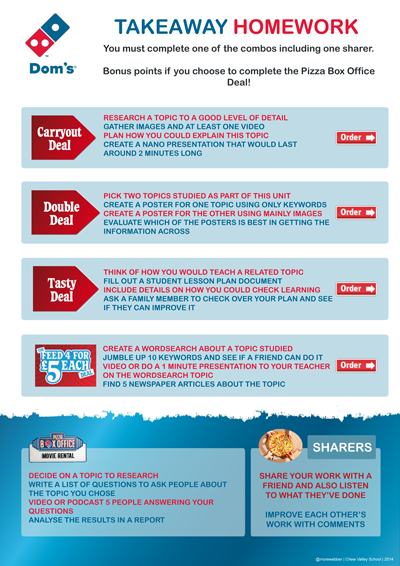
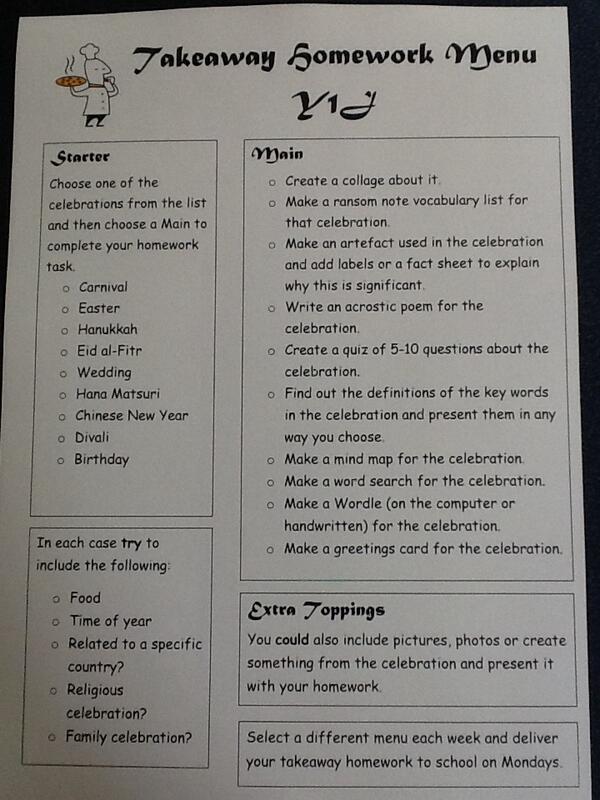
"One of our takes on "Takeaway Homework". In the style of Dominos ” this is a high school e.g.

  1. thank you! Do you mind if I add to crowd sourced doc, or can you add to comment on blog so
  2. will do - got others too. Parents encouraged to take the idea as far as their child wants
  3. but the most important in my book is still reading - for meaning. I give parents questions


topic was celebrations, had meeting for parents to explain &showed examples I made to give them some ideas.


Shared by @Mrs_Twit24 though layout was devised by someone else

  1. I like those philosophy for children questions....would you rather...?


    1. hmm I don't agree with home learning so young which is why we do projects giving them half a term

      I have the same issue with Y2/3. I'm going to do takeaway h/w next term and explain that they need to expand not just advance