Thursday, February 19, 2015

More incredible learning at home: The Great Fire of London


I have blogged about homework before (we call it learning@home) and know that some teachers have appreciated seeing the work that we have completed and the ideas behind them. Others have debated the usefulness and impact of homework, but it is an expectation that we provide it. I have tried to make it as meaningful as possible by linking it in to the work that goes on in class. This homework activity sheet went home to all families at the beginning of January and every child bought in a piece of work before half term. Yes they varied in the amount of adult support that the child received, but I actually don't have a problem with this. In the same way that I wouldn't expect a child to bake on their own (and I understand that they can experience rich conversations and  new language whilst doing so), I feel the same about some of the models that have been created. It's clear that they haven't been achieved independently, but I imagine the quality family time that has hopefully happened. Even more important, the children are incredibly proud and very keen to show off their learning at home. We certainly celebrate their achievements in class!


A sketch of the new St Paul's


Tudor houses

Tudor houses


An incredible project about the Great Fire of London and another fantastic model of St Paul's Cathedral. 


 A church that burnt down in London


Thomas Farynor's bakery buns


We all appreciated these - they were delicious!


The bakery fire
Tudor recipe books, diaries, pictures, posters, fact sheets and top trumps cards.

Our display is growing!


Sunday, February 8, 2015

What is an algorithm?


Trying to teach your children what an algorithm is, but not sure how? Well there's plenty of support out there that will help you become more confident when teaching your class to understand what it means - and how to write them.

The BBC describe algorithms as a list of rules to follow in order to solve a problem. They have kindly created a page called Code Needs Algorithms, which is part of their What is an Algorithm? Bitesize pages. You are reminded about the times that you have already used algorithms, such as map directions and instructions for how to make things. There is a handy video that you can play to your class before starting work. With the pages on digital literacy, it's a nice gentle way to get you started on the computing curriculum.


When the light bulb pings and you realise that you have used algorithms many times before, without naming them, you realise that there are many ways you can extend learning through other curriculum subjects. Barefoot Computing have put together a lovely little KS1 activity called Crazy Character Algorithms that, even if you don't use it yourself, will surely spark some ideas of your own.

Stuart Hadfield, a member of CAS, has put together a page of ideas for introducing algorithms to children in reception class. If you look back at my previous posts you will find some great resources that enable children to write and use algorithms.


Writing algorithms in key stage 1 and 2 with Scratch


Scratch has been around for a while now and in my opinion is a great tool for early computing, not just because it is free, but because  it allows children to use their creativity and create a wide range of projects independently. It can be used as early as year 1 and many infant teachers have used it successfully. I have used it with my more able children in KS1 and infant digital leaders.  For KS2 children it satisfies the very first bullet points of the new curriculum:

  • design, write and debug programs that accomplish specific goals, including controlling or simulating physical systems; solve problems by decomposing them into smaller parts
  • use sequence, selection, and repetition in programs; work with variables and various forms of input and output 
  •  use logical reasoning to explain how some simple algorithms work and to detect and correct errors in algorithms and programs


Having Scratch on an ipad is a bonus too, as it is a great introduction to the more in-depth projects that can be achieved on a PC. The basic app is free, but you can buy Scratch games too, which provides video tutorials for creating your own games.


There are many scratch experts out there and I have never felt the need to create my own resources because of this. Before I found them, I used the cards and projects from the Scratch site to show children the basics and what could be achieved, then I let them explore. When they learned new skills they taught one another, consolidating their own learning in the process. Simples! Don't be afraid to let them take the lead. If they own their learning, they are much more likely to extend it. I know the basics and am able to help to a certain point if weaker children got stuck, but if I didn't know an answer I modelled great problem solving skills, trial and error and perseverance. Still great teaching in my opinion! Children have loved creating simple games, from the very basic car track to angry birds games. Thanks to Phil Bagge (@Baggiepr) who has created a sequence of Scratch programs that can be used for year 2 up. Simon Haughton has also created Scratch resources and has a website  devoted to all things ICT/computing.


Part 2 coming soon!


Saturday, January 17, 2015

Challenge (in the primary classroom)

I have been thinking a lot about challenge in the primary classroom and what it actually looks like in practice. From experience, discussions with other practitioners and through social media, it appears to be something that is hot on the OfSTED agenda (see below). Whilst I don't believe that schools should be doing things for them, I do believe that getting the best out of children comes when appropriate challenges are planned for.  So what does that mean? If you look at definitions from the Oxford dictionary:


Challenge: A task or situation that tests someone's abilities. Makes demands on.

A challenge problem: one that offers interesting difficulties


So let's take into consideration the National Curriculum 2014, which states that

 ‘Decisions about when to progress should always be based on the security of pupils’ understanding and their readiness to progress to the next stage. Pupils who grasp concepts rapidly should be challenged through being offered rich and sophisticated problems before any acceleration through new content. Those who are not sufficiently fluent with earlier material should consolidate their
understanding, including through additional practice, before moving on.’

The important part (in my opinion) is that they are challenged, before being moved on. We've all had those conversations with parents who want their child reading books far beyond their understanding, or completing mathematical calculations that they are unable to apply in real life.
 The teaching standards state that a teacher must:

1. Set high expectations which inspire, motivate and challenge pupils

Simples?!

So how do you know if you are doing that? For me, it's not just about whether they are making progress, it's whether you are fostering curiosity and a love of learning through your teaching - and how much ownership children have. In my mind that (love of learning) is a much bigger challenge than showing that you have helped them move on 2 sub levels in a subject, in a term. In my year 2 class this half term it has felt quite easy, with the topic of the Great Fire of London. Yesterday, my TA came back from taking a group down to the library and, in her words, was completely amazed by what they know and how they were talking about it passionately. A great topic can inspire this passion for learning and children are continuing their learning at home because they are interested. Next week I shall become a teacher in role as the maid one day and Samuel Pepys another. Experience tells me that the quality of writing produced afterwards will be much higher than without the drama. Appropriate challenge in the form of engaging their emotions and creating opportunities for them to ask questions.


GFoL movie made (and acted) by a 6 year olds last year


Reflecting further on my own practice, there are many ways that I believe I offer challenge, not just through differentiated tasks, but through the way that I refuse to spoon feed children (I've written a bit about that here).  They are expected to try, to use their initiative and to consider previous learning that may help them solve current problems. I know when direct teaching is needed, to rectify misconceptions (or teach to prevent them) and when they just need to learn things by rote (in an infant style of course!) I started to list all the ways that I felt I challenge children, from open-ended child-led tasks in maths, to mantle of the expert and enquiry led topic work.  My list started to grow, but as always I want to learn if there is anything else I can do, so I decided to share it as a crowd-sourced document in the hope that others would contribute to it. When you look at it, consider how many approaches you have used in the classroom.


.......................................................................................................


The OfSTED part

I have picked out some relevant parts from OfSTED guidance and have found this web page - OfSTED 2012: Challenging tasks matched to children's learning needs - interesting, especially the bullet points saying why and how.

Much of the following is lifted from guidance and is a little disjointed, but relevant to this post.

OfSTED guidance states that inspectors must consider whether teaching engages and includes all pupils with work that is challenging enough and that meets the pupils’ needs as identified by teachers. They will consider whether assessment is frequent and accurate and is used to set challenging work that builds on prior knowledge, understanding and skills.

Inspectors must consider the rigour and effectiveness of systems to drive improvement, including:


  • monitoring the quality of provision and children’s outcomes; the professional development of staff; evaluation of the impact of actions taken; and setting challenging targets 
  • (The lesson's) effectiveness depends on the impact of the quality and challenge of the work set.


Evidence of learning over time may include:


  • the level of challenge provided, and whether pupils have to grapple appropriately with content, not necessarily ‘getting it right’ first time, which could be evidence that the work is too easy (183).


And under grade descriptors:

Outstanding - Provision across all areas of learning is well planned and based on regular and precise assessments of children’s achievement so that every child undertakes highly challenging activities.

Good -  Learning opportunities are well planned and based on regular and accurate assessments of children’s
achievement so that every child is suitably challenged.


Jackie Debeere has written about the perfect ofsted lesson, which is a good read.

Sunday, January 11, 2015

Blind date with a book


I wanted to share this fab idea that one of my colleagues (Lovely Lisa!) shared with me. She had seen it at a reading conference, so I apologise for not accrediting the initial sharer of the idea. We both now give our children the choice of changing their reading book in the normal way, or selecting a blind date book. 

Algona Public Library


Each blind date book is wrapped so that children cannot see what they are getting. I teach class 2, so the books may be at the appropriate level, or a challenge for the child. I preempted confusion about this by sending a letter home to parents explaining about blind date books and that they are for reading alone or sharing together. I have included favourite class stories, picture books, early independent readers and some longer stories, which get put into a 'blind date tub'. Not only does it introduce children to books they may not usually choose, it makes them read (or read more quickly) at home because they are keen to choose another blind date book. 

Interestingly, two children at the end of last half term chose not take a blind date book. One of them was keen to read the last book from our reading scheme boxes, the other child just didn't want to take the risk!

You can see some more examples of blind date books on pinterest.

Friday, January 2, 2015

#Nurture 14~15

This is my first nurture post. I am writing it as part of my own well-being as I think it will be beneficial to think about all the positives from 2014. I didn't write one last year as all I wanted to do was settle into my new role and keep on learning. I believe I've achieved both!

So here are the best bits of 2014, in no particular order.

1. The spring and summer term of 2014 were particularly challenging, both at home and school, for many different reasons, but I finished the year with an overwhelming feeling of fulfilment and achievement. Sometimes, things that break your heart ultimately help you become more resilient. I have been incredibly well supported in my first post as a Deputy / SENDco and am proud to work with a team who care immensely about the whole child (not just the education bit). I have learned a lot about myself and am still striving to do better. Although everything happens at a fast pace, I believe that I have a relatively good work/life balance as I do manage to catch up with different friends every weekend and I get to the seaside often. Thanks @JenniH68 for all our Bicycle Shop/Prison Cafe jaunts in 2014, for being my inspiration and sounding board, for your wisdom and your silliness. You are my peacock-haired edu-twin!

2. I have survived my first OfSTED as SENDco (and Deputy). Phew. I have written about that previously (see SENDco posts).

3. I completed the Norfolk Talent Pool training and made some new friends and acquaintances on the way. There are lots of people I respect in education in Norfolk, but few as passionate and enthusiastic as @ms-jamdangory. It was lovely spending time with her. Spending my internship at West Earlham Infant School was also great (thanks @BinksNeatesEvans!) as it confirmed my strengths whilst providing food for thought and highlighting areas that I needed to develop. If the government were going to put one effective cpd strategy in place, then I think internships could be it. It's amazing what you can learn from other schools - that's why I loved being an AST so much. I read somewhere that the best schools are the ones that continue to look outward - and I strongly believe that.

3a. I passed the county moderation tests to become a ks1 moderator, just after OfSTED's arrival. I'm just pointing out here that I had to moderate work and write questions that I would ask the teachers about the child's maths, reading and writing, in the time the ks2 folk had to do just writing. I'm just saying, that's all.

4. I have managed to continue reading for pleasure throughout the year and our mini book club is going well. I have read books that I would never choose for myself - and enjoyed them! Notable (enjoyable) books in the last year were: A Tale for the Time Being, The Thirteenth Tale, Blood Song, The Girl on the Landing and We are All Completely Beside Ourselves. The time I spend reading has increased because the time I spent on twitter decreased significantly last year. I was very shocked by the public bashing some teachers were giving each other last year - we are all doing the same job and it's tough at times without 'colleagues' trying to ridicule each other. I realised long ago that my internet connection (and synapses if I'm honest) are not quick enough to enter a debate where you are limited to 140 characters and I admit that I have mostly shied away from sticking in my two-penneth worth. That said, I would like to bash some twitter heads together! Education is made up from many different subjects and teaching styles and thank goodness for that. People have different opinions and they can be as valid and valuable as each other. If I had been stuck with traditional teachers for my whole education I would have failed even worse than I did. Thank goodness for the variety! The point is, that I continue to read what positive disruptors have to say, because they challenge thinking rather than insult people, but the ones that are down-right rude I pass on by. Try it - you'll be amazed at how much time you save! (I have added to the end of this post the blogs that I continue to read, because they inspire/help me do my job well).


5. I was asked to deliver the keynote at an ICT conference in March 2015, which was a lovely surprise, mostly because I have been less vocal about ICT/computing over the past few months. I'm honoured to be the positive female role model they were looking for - there are plenty others out there that I know of who are passionate educators too. I hope I can inspire the people who come (I'll be trying my damnedest!)

BB Janus!


Hopes for next year

I have many work based hopes, but in some ways the most important hopes are for my friends, family and personal well-being. I have no doubt that my work based hopes will be realised through hard work, great team work, enthusiasm, dedication and the passion that comes from colleagues and I wanting to be the best that we can can be.

1. I hope my son Ben pulls his finger out and gets some work done at uni! I'm dead proud of him, but he has not inherited my ability to balance social life with a good work ethic! In terms of deadlines, he's very last minute. com! Conversely, Jake can balance both and I'm extremely proud of his achievements, though I rarely appreciate his happiness in the middle of the night - especially on a school night!

2. I hope that my closest friends stay happy and healthy. They are my rocks and they keep me grounded (plus they always humour my hair-brained ideas.)

3. I hope I find a yoga class that I can get to. I've not managed Zumba for a whole term and it now feels impossible to go back :-/ I recognise that exercise is essential for my wellbeing though - and last year it meant that I caught up with another close friend each week. I need to reinstate this.

4. I hope that #DLchat and the digital leader network continue. I know that the numbers have reduced, but there are some amazing digital leader advocates out there. I truly believe that all schools should employ them, I just don't have enough time to shout about them through social media so often nowadays. I often get emails from other teachers asking for advice or talking about their achievements and it is lovely. Wouldn't it be even lovelier if all local authorities invested in a DL advocate for each county? Of course some counties are lucky. Bradford has @chrismayoh, @pederosa and others; Yorkshire has @gr8ict, working tirelessly to support and promote DLs; Norfolk has @L_S_Stone (who is keeping the DLN going at present-thank you!) @kevin_sait and @kezmerrelda (and me of course!); Brighton has @traceyab1; Arden has it's DLs, @Lizsaddler and @Danielharvey9; @headdowneyesup down South and @robertd1981 up North; and of course there's @clcsimon and @beklayton who I have got to know this year as other hugely dedicated and passionate educators. Three mighty giants, @ictevangelist, @milesberry and @chrismayoh have continued to support through #DLchat and the UK is lucky to have Chris back with his wit and (huge) wisdom. They are but a few people who deserve a mention.

5. I  hope that the crops of ulcers that I have had in my mouth for many years continue to stay away. Despite last year being frantic at times (and my sleep patterns haven't improved), my mouth has not suffered like it has previously. This makes a huge difference (anyone who suffers with ulcers will know exactly what a relief it is to have none).

Gosh, that's 5 hopes done. I could have written many more! I'm not sure anyone will read this, but it's been quite cathartic writing it, which I guess is the whole point.


People whose blogs I read regularly, because they inspire me, help me do my job well or save me a lot of hard work (or all three!). Thanks to:

Mary Myatt - lots of fantastic pearls of OfSTED wisdom here!
Michael Tidd- brilliant resources for the new curriculum
Cherryl-kd - SEN goddess and lovely lady, with pertinent posts
Miles Berry- my computing/ICT hero
Tim Taylor - creative, lovely chap who is well read and a huge font of knowledge
Mark Anderson - ICT genius
Chris Mayoh - another ICT genius!
Doug Belshaw - for open educational thinkering 

I read others from twitter links, like @teachertoolkit, @debrakidd, @emmaannhardy and @beklayton, @learningspy, @oldandrewuk and @headguruteacher but the ones above are more relevant to primary or ICT.

Monday, December 29, 2014

Espresso Coding

We made the most of the Espresso coding resource whilst it was free for schools, then purchased it to complement existing resources and to support teachers to deliver certain aspects of the computing curriculum. We are very fortunate to have the Rising Stars Switched on ICT scheme, which supports teachers to use ICT creatively, but this makes sure that the coding aspects are covered, such as the first few bullet points of the computing curriculum at KS2:

Pupils should be taught to:
  • design, write and debug programs that accomplish specific goals, including controlling or simulating physical systems; solve problems by decomposing them into smaller parts
  • use sequence, selection, and repetition in programs; work with variables and various forms of input and output
  • use logical reasoning to explain how some simple algorithms work and to detect and correct errors in algorithms and programs

The Espresso Coding resource is split into year groups with a starter, and 2 units for each (apart from year 1). 


Overview showing skills progression

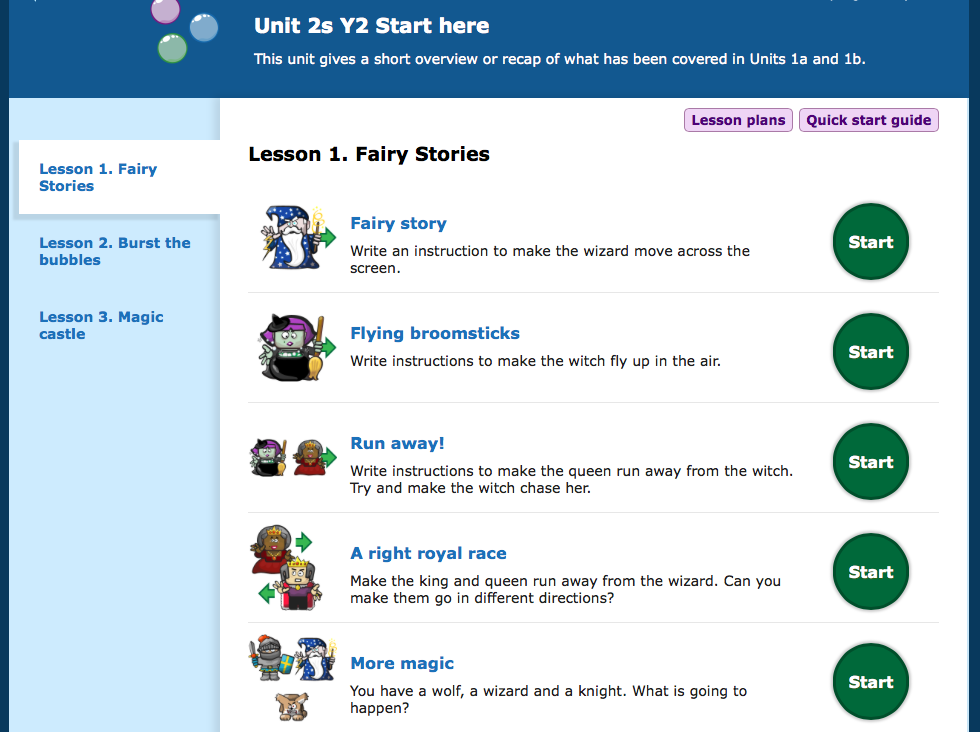
The year 2 starter unit, for example, is split into 3 sections, which review and recap the objectives taught in year 1.  The quick start guide offers an overview with the learning objective that is covered and a rough idea about the timing for the whole unit. 


Once you have finished the starter units, there are a further 2 units with up to 7 sessions in each.  With one session a week this resource will support over a term's worth of teaching. It really will support as well, because lesson plans and tutorials are provided. 


When I introduced this to my year 2 class, I first let them explore the year 1 units. This is because they haven't seen them before and I want them to feel confident navigating around the resource. They have since been totally engrossed each time we have used this. What I really like is that at the end of each unit children get the opportunity to build their own app, using the skills they have learned in each unit.  So, for year 2s, they get to decide what will happen to objects when they are clicked. The session at the end of unit 2b concentrates on debugging exercises, helping to cover the program of study at ks1 perfectly!


Choosing your characters and background 


With my year twos I have offered very little teaching input as I have been curious to see what they do independently. Certain children have needed support in the form of encouragement, though the majority have been able to navigate around the activities and solve them independently. I find that mixed ability pairing works well in these situations, though I have to monitor carefully that each child in the pair is working and understanding what they are doing.  For trickier sessions and assessment, I split the class in half so that I can concentrate on more children. 

Espresso Coding supports teachers to deliver the coding part of the curriculum and sits very well with other resources, like Kodu and scratch, because it makes sure that all skills are covered (the overview photograph above shows how the progression of skills are covered). It supports teachers because it is more structured and because the tutorials and lesson plans are helpful. 


Tutorial videos
In my opinion, Espresso Coding sits very nicely with the other apps and resources that we have in school. If you do invest in it, invest in staff meeting time too. I would recommend a session for teachers to play themselves, then a follow up session the next half term where teachers are expected to feed back their own and pupil's views. If you're paying for it, you need to ensure it is used!


Lesson plan

Sunday, December 28, 2014

Tangram

This app is free today via apps gone free and is another good app that allows children to learn and create. In the models section there are 12 animals to create, some scaffolded with the shapes showing. 


The shapes are drag and drop- easy for little fingers to manoeuvre. The build section lets you explore your creativity, then allows you to move your creation around the screen, save it and photograph it. 


It's a great little freebie that once again satisfies elements of the computing curriculum at ks1.